
About
Michele Palermo is a creator, a writer, a wife, a daughter, a sister, an aunt, and a friend. Someone who has spent her life finding ways to bring stories to life on stage and screen, big and small.
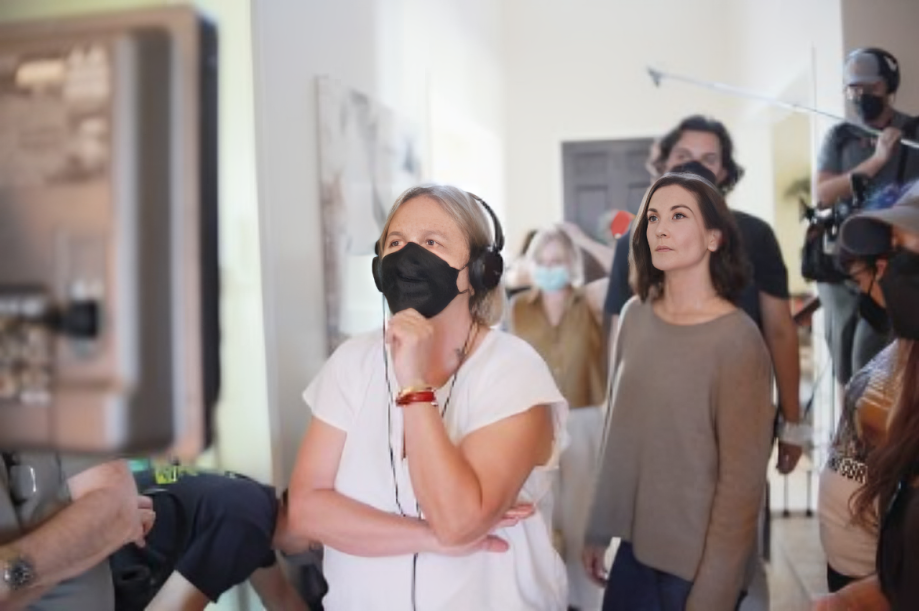
She spent time in New York as head writer on the premiere season of The Martha Stewart Show, researching, as she will tell you with complete sincerity, such riveting topics as compost, tomatoes, and how to wash your dog. She has never composted since. She has, however, served as Chief of Staff to the First Lady of Virginia, produced USO tours around the globe, and turned down many offers to open a restaurant. She only cooks for those she loves.
About
Michele Palermo is a creator, a writer, a wife, a daughter, a sister, an aunt, and a friend. Someone who has spent her life finding ways to bring stories to life on stage and screen, big and small.
She grew up between Milwaukee, Wisconsin and Rome, Italy — including one year in an Italian school where she arrived not speaking a word of the language and finished second in her class, which explains a great deal about her. After college she moved to Washington, DC to work as a French and Italian translator at a law firm while building her career as an actress. She earned her Master’s degree in International Communication at American University.
Before any of that, she spent time in New York as head writer on the premiere season of The Martha Stewart Show — researching, as she will tell you with complete sincerity, such riveting topics as compost, tomatoes, and how to wash your dog. Pages and pages of bullet points. She has never composted since.
She has, however, served as Chief of Staff to the First Lady of Virginia, produced USO tours around the globe, and turned down many offers to open a restaurant. According to her friends, she is one of the great cooks of her generation.
It was in New York, in a small apartment on West 51st Street, that she began writing plays with her husband Paul. Her first play was Ladies in Waiting. Those early plays were published by Samuel French. West 51st Street Productions — her first production company, named after that apartment — was born there too. She now rents in that same building every spring when she returns to teach at Columbia. Some addresses stay with you.
She came to Los Angeles after being cast in the film Broadcast News. She played William Hurt’s makeup person — her scenes with him in the makeup room before the famous emergency broadcast were cut from the finished film. She discovered this at the LA premiere.
What remained was a single line, delivered on stage after the broadcast: “Congratulations, Tom.” She stayed in Los Angeles anyway. She has never entirely stopped being grateful for that cut, because what came next was more interesting than anything Hollywood had planned for her.
Television found Michele the way the best things do — unexpectedly. A TV executive saw the premiere production of Ladies in Waiting and recruited her into the industry. A published and award-winning playwright focused on telling women’s stories, she went on to write myriad pilots and episodes, develop series with Peter Horton and David E. Kelley, and sell The Mansion — an upstairs/downstairs dramedy set in a Governor’s mansion — to Lifetime Television. She wrote for a network primetime series. She pitched in more rooms than she can count. She also wrote, produced, and directed two award-winning independent features, Ladies in Waiting and the mockumentary Unreel: A True Hollywood Story, as well as the popular web series Chapin Circle.
And when Hollywood couldn’t find a box for the show she needed to make next, she made it herself. MIDDLEHOOD — written, directed, produced, and edited entirely by Michele, all eight episodes — became the first truly independent television series ever made in the United States, and the first of its kind ever considered for the Emmy Award and the SAG-AFTRA Actor Awards. It is streaming now.
In addition to continuing to write, direct, and produce, Michele is training the next generation of storytellers at Columbia University, at La Fémis in Paris, and at FAMU, the Czech national film school in Prague — teaching them what she had to learn the hard way: that the table already exists, you are allowed to sit at it, and if no one will pull out your chair, you build your own.